Berriedale is approximately 6 miles north-east of Helmsdale. The Patrol was made up of men from the Duke of Portland’s estate which was the main employer in the area.
| Name | Occupation | Posted from | Until |
|---|---|---|---|
| Sergeant John F. Murray | Head gardener |
Unknown | 03 Dec 1944 |
| Corporal Alexander Thomson | Gardener |
Unknown | 03 Dec 1944 |
| Private James Murray Gunn | Crofter |
Unknown | 03 Dec 1944 |
| Private Donald MacLeod | Gamekeeper |
Unknown | 03 Dec 1944 |
| Private J. Matheson | Unknown | Unknown | |
| Private John Forbes Murray | Unknown | 1942 | |
| Private James Sutherland | Unknown | 03 Dec 1944 |
Situated west of Langwell Water opposite 'Weather Vane' and 'Turnal Rock'. It utilised an old ice cave. Inside were bunks, hand grenades, tinned rations and paraffin for the heater.
Today the area is open and exposed, but was covered with deciduous trees during wartime. There was some thinning out post war and replanting. Nothing remains at the location of the OB.
An Observation Post was situated nearby and had a field telephone with communications cable leading to the OB.
Berriedale Patrol
It is believed that the primary target for the Patrol was the Berriedale Braes. The main road from the north drops down 13% over 1.3 km before composing Berridale Water and climbing sharply again. In wartime the road was considerably narrower and included hairpin bends. It was an ideal point to hold up any force landing to the north. The road had already been fitted with a flame trap, with copper pipes running from a fuel tank near the church. They were perforated every few feet. Pulling a cable near the Smiddy, home to the estate blacksmith, would pour fuel on the first German convoy through and the forge would provide a fire to ignite this. After this the Patrol would have to set charges on the bridge or at other points to further delay a German force. There were very few regular forces in Caithness and the purpose of the Patrols was to delay any German advance until reinforcements could arise. It might seem an odd location to expect a landing, but the fear was German troops sailing from Norway as the Vikings had done centuries before.
The railway line runs far inland at this northerly point due to the difficult terrain. Other Patrols were closer to deal with this.
They trained locally within the grounds of the Langwell Lodge Estate and also other training provided by Scout sections from the Seaforth and Cameron Highlanders at Golspie and as far as Blairmore House. For a period Captain Fiddes-Watt was based at Berriedale along with Lt Bain, their wives and the “Langwell Boys”. This may refer to the Patrol, or to a Scout Section under Lt Bain, not enough evidence survives to be sure which.
John Murray mentioned Sten guns. His grandson recalled getting in trouble for uncovering Sten guns kept in the loft of the Langwell seed store. He recalled they were covered in a waxy substance and wrapped in oily cloth. They were removed by the Army along with a few surviving grenades stored with them.
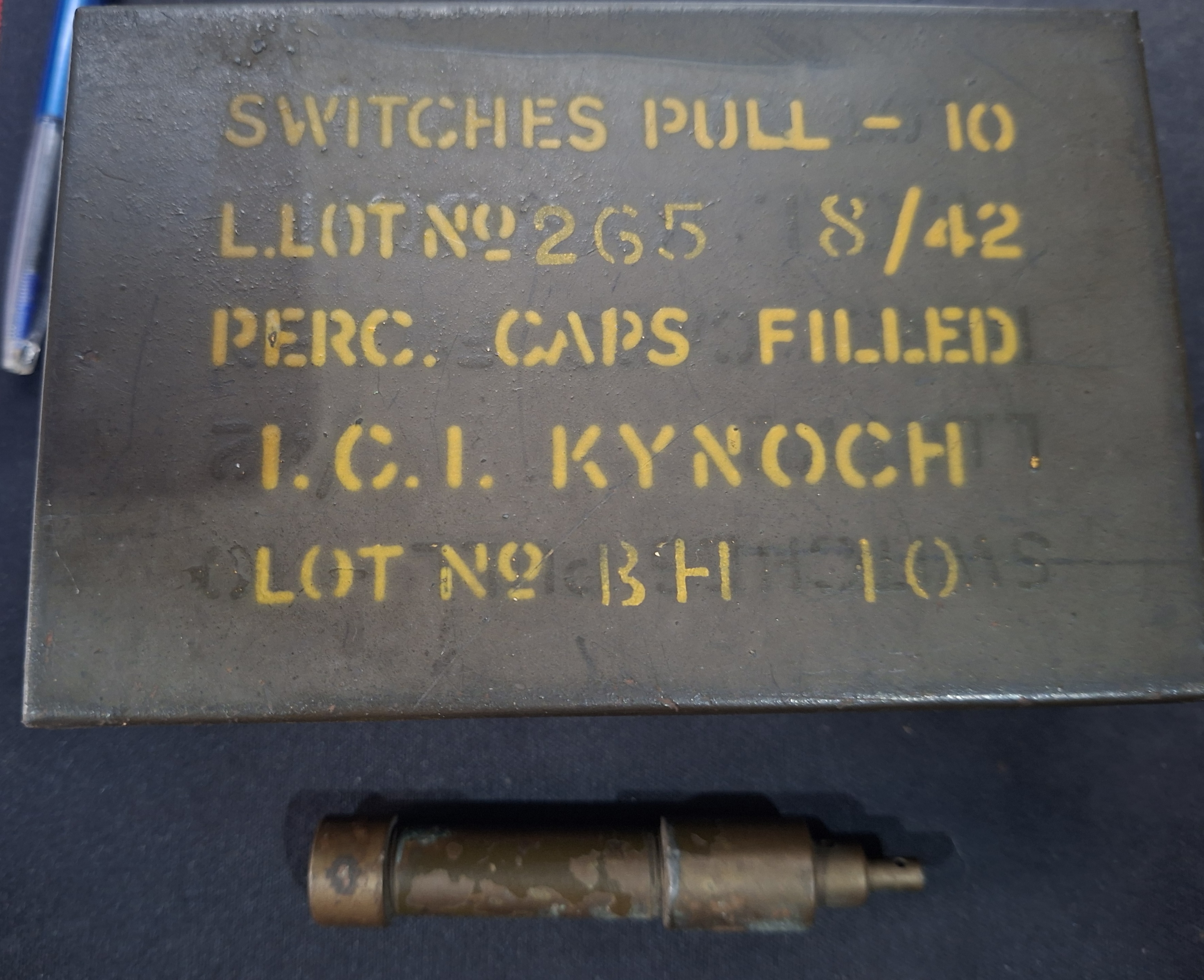
The grandson was allowed to keep a tin for pull switches and a single pull switch. The tin was dated August 1942, indicating the earliest it can have been issued to the Patrol. Elsewhere in the country, wooden boxes of 50 pull switches were replaced by several tins of 10, presumably as they kept better while still sealed.
Reportedly, the Patrol arranged a male only party at the Portland Arms to celebrate stand down.
Sergeant John Murray, arranged to blow up unstable explosives in the OB after the war so that almost nothing remains. He had approached the Royal Engineers in early Jan 1976, to ask them for help with disposal. An officer came to review the site but seeing the boxes deteriorating, declined to get involved, saying that as they were not officially recorded as far as he was concerned they did not exist. So his sons Andrew and Jack, both ex-services, set charges to explode the whole lot and also to bring down the entrance and seal the remains. The newspaper recorded that the work was done by the Bomb Disposal squad, destroying 46lb of explosives, including 94 sticks of weeping gelignite, in 5lb amounts. The photograph is believed to show the small store, near the track to the Wagg, being demolished because of concerns that walkers might come across it.
Geoff Leet's article in Caithness Field Club Bulletin 2005
Hancock data held at B.R.A
TNA ref WO199/3388
Private Correspondence with David Blair
John O’Groat’s Journal 16 Jan 1942, 7 Jan 1976
Aberdeen Press and Journal 3 Jan 1976