The Paraffin Incendiary was also known as the Tyesule
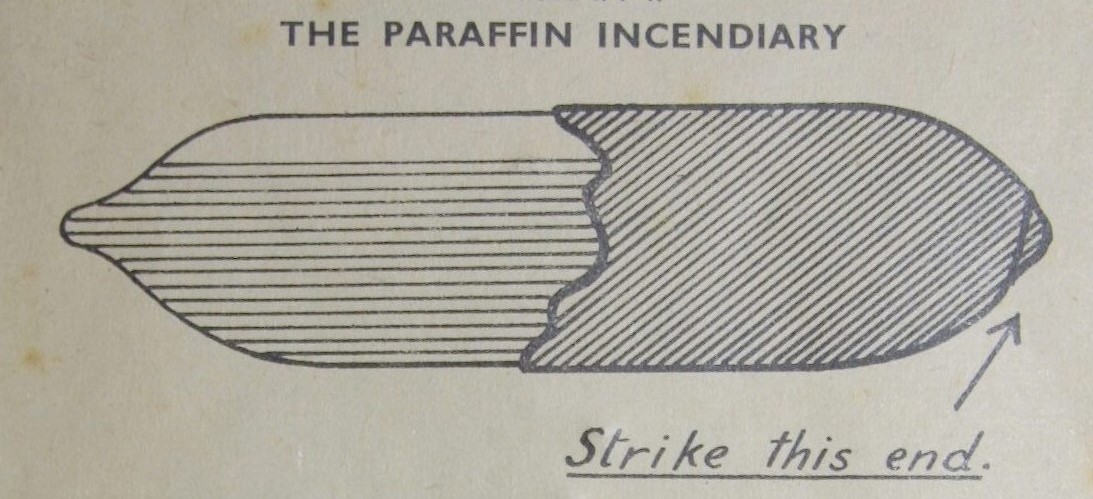
It measured 5 inches overall length by 1.25 inches maximum diameter
It is thought that it was derived from the Giant Tyesule. This was a prewar product consisting of a paraffin filled gelatin capsule designed for refilling lighter and other similar products. It was made by John Tye & Son Limited, 457 Caledonian Road, London N7. They were manufacturing chemists and capsule makers whose products included Tyevite vitamin capsules. Colonel L J C Wood and Dr F A Freeth of Aston House (Station XII) are credited with the invention of the Tyesule as an incendiary. Both had joined Section D before the war and had been at Aston House since November 1939. The key development was to coat one end of the gelatin capsule with match composition. This could then be struck on a matchbox or striker board, in order to set the device burning.
The paraffin incendiary featured in the large dumps being created by Section D in July 1940, confirming they were in bulk production by this date. They were issued in cartons with 12 in a tin and 15 tins in a large dump. The 1937 calendar also makes reference to the cartons. It says, “These tubes of petrol and paraffin mixture are sometimes packed in cardboard cartons with specially inflammable material.” It explains how a time pencil could be inserted with the cap end adjacent to the match composition material, allowing delayed ignition of the incendiary, the lack of a delay being a major drawback in the design otherwise. In use, it was suggested that it be placed where the burning liquid could run downhill or through cracks to spread the incendiary effect as far and as quickly as possible.
The description of issue of the cartons in a tin of 12 suggest that they may have been using tins originally designed for the Giant Tyesule as these were just the right size to hold 12 cartons. Later a record from Gherkin Patrol in Kent records that their training stores include “1 box of paraffin incendiaries”. The number in the box is not recorded, nor the type of box.
%20Normandy%20June%202019%20.jpeg)
Various other Auxiliary Units Patrols note having paraffin incendiaries (never apparently using the term Tyesule). On October 18 1943 the Southwick Patrol saw a paraffin incendiary ignited in a demonstration along with a Magnesium Incendiary. The Patrol diary mentions large and small paraffin incendiary devices though there are no other references to devices of different size. The Grange Patrol in Scotland also had a similar demonstration. They also used one on a weekend camp as a firelighter, with rather dramatic results!
Paraffin Incendiaries were also dropped to resistance groups in occupied territories by SOE. Named as the Tyesule, they appear in an SOE training syllabus.
It is thought that after 1943 they fell out of favour and cease to be mentioned in documents or equipment lists.
SOE Equipment Air Dropped in Europe 1040-1945, Anders Thygesen and Michael Sode (Ed Norman Bonney)
SOE’s Secret Weapons centre: Station 12, Des Turner
1937 Calendar
The National Archives CAB 120/241
IWM MUN 3833 www.iwm.org.uk/collections/item/object/30023471
SOE Heroines Bernard O’Connor