Alexander Fraser was born on Friday, the 22nd of October 1896, and as a child, he grew up on the North Lynn Farm in Peterculter, near Aberdeen. Fraser served with the Gordon Highlanders in France at the end of World War I but never saw active service. He was moving from North Lynn Farm when his family took up the tenancy of Artrochie, one of the Achmacoy Estates near Ellon, Aberdeenshire. Later, Alexander Fraser took up the tenancy of North Artrochie, and when his parents retired, he took the tenancy of the larger Artrochie Farm.
At some point in the early part of the war, Alexander Fraser was approached about setting up a secret organisation in the area to undertake resistance and guerrilla activities should the country be invaded. Upon taking up the position, Fraser was appointed a Lieutenant and placed in Group 7 under the 201/GHQ/Reserve Battalion (Auxiliary Units).Responsible for the Fyvie, Newmachar, Slains, Tarty and Ellon Patrols, Lieutenant Fraser visited these patrols, ensuring their secret role was maintained and that they were ready for action should they be called on.
Alexander Fraser’s son, Norman, recalls a boy being with his father to visit the patrols under his command. One of his recollections is of moving through the gates to Fyvie Castle and seeing a Bren Gun Carrier at the castle gate, which sat there guarding the estate. Norman recalls his father signalling to the Bren Gun carrier and driving a short distance into the Fyvie Castle grounds, where people suddenly appeared through a trap door in the leaves underneath some trees.
Petrol was rationed during the war, and very few people in the area had cars. It is unclear whether Lieutenant Fraser owned or had access to a vehicle, but he certainly could get petrol. Lieutenant Fraser’s son Norman remembers visiting Sergeant Alexander Moir at Mintlaw after the winter of 1941/2. Norman remembers his father saying, “I have to visit my Sergeants.”Norman also recalls, “Our back room had so many explosives and things kept there, we could have blown ourselves off the map. I have memories of several soldiers at the house sitting outside on a pleasant evening, each with a jute bag full of tacks for their boots. The group had just been issued boots, and the soldiers were tapping the tacks into the soles”.i
Although Fraser was a farmer, his son remembers him rarely working on the farm and always being away on military matters. This involved trips to Blairmore House near Huntly, where he was photographed during training on explosives and weapons. With this training, Fraser became an expert in explosives. During one of the times Fraser was at Blairmore, Norman had been playing with a boy who stayed in the Lodge at Achmacoy. The boy’s father was a driver for the Earl of Caithness, the Laird of Achmacoy, who resided at Achmacoy House. On Sunday, the 12th of October 1940, while Norman was on top of a hay bale in a farm steading, the boy pulled out matches and set fire to the straw. As it was late in the year, straw had been stockpiled for the farm animals to come in for the winter, resulting in a rather large fire that spread. Several locals attended the fire and used ladders to remove roof tiles and other materials from a nearby building, preventing the fire from spreading. Fortunately, the fire never reached the farmhouse, which housed all the explosives. A newspaper story stated Alexander Fraser was “absent on Home Guard duties over the weekend”.
All the ammunition and weapons were collected and stored at the end of the war for future use. However, the Frasers were left with a surplus of explosives. They established a roaring trade in blowing up rocks in fields too big to lift during ploughing. On some edges of the fields, rocks show signs of blasting across seams with clean splits.
Norman learned how to prepare and detonate explosives, and he recalls blowing up a rock in a field all by himself at the age of 12. Having prepared five sticks of dynamite and the detonator, he lit the fuse using a trick his father had taught him, which achieved a 100% success rate in all weather conditions. This involved using a match and angled cuts in the fuse wire to hold the end of a matchbox.
However, dynamite wasn’t exclusively used for rocks. Norman remembers a haystack full of rats. His father made a circle of dynamite around the haystack and detonated it. He recalls seeing smouldering rats fleeing the explosion and, in turn, finding other nearby rat holes to retreat to, resulting in all the rats fleeing the danger. The farm was rat-free for several years, as Norman recalls.
Like virtually all other Auxiliary Unit members, their service was never officially recognised or discussed at the war's end. Norman remembers his father taking the Armistice Day parade in Ellon in 1946. Alexander Fraser moved to Ellon in 1969, where Norman’s brother took over the farms. On Tuesday, the 13th of April 1971, Alexander passed away at the age of 74 at home in Ellon.
| Unit or location | Role | Posted from | until |
|---|---|---|---|
| Aberdeenshire Group 7 | Group Commander | Unknown | 03 Dec 1944 |
Farmer
Group Commander of Group 7
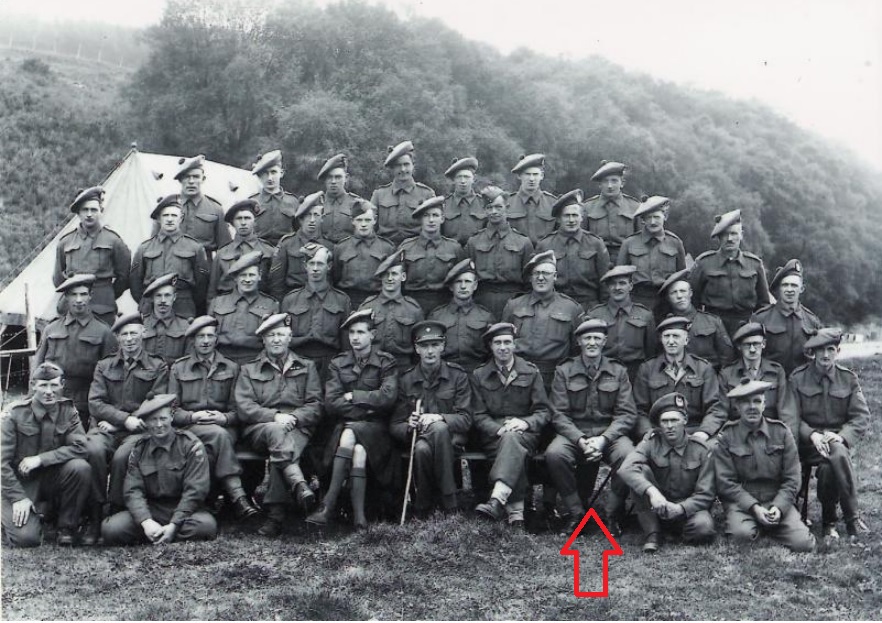
TNA ref WO199/3388, Hancock data held at B.R.A, Son Norman Fraser